From a team of one to a design team grown in-house
I started as the only designer. I built the team through a paid internship program, hired all four designers from it, and set up how we run: clear owners, a weekly rhythm, an activity log, and a burnout chart. After a 2026 reorganization, three of us still ship the whole suite.
- Role
- Lead Product Designer, then Head of Design
- Team
- From 1 to 4 designers + 2 interns. 3 of us today
- Covers
- 3 product areas, ~25 engineers, 4 PMs
- Timeline
- 2020 – present
- Designers hired, all from my own paid internship program
- 4 of 4
- Designers hired, all from my own paid internship program
- Sprint tickets with approved design before the sprint starts
- 55% → 92%
- Sprint tickets with approved design before the sprint starts
- People who quit the team since 2020
- 0
- People who quit the team since 2020
- Design time spent on roadmap work, from the activity log
- 58% → 74%
- Design time spent on roadmap work, from the activity log
How the team grew
- 2020A team of one. I was the only designer, so I started a paid internship: real tickets, real responsibility, real production work.
- 2022The first two hires, both from the program.
- 2023Two more hires from the program, onboarded and supervised by the first two. I become Head of Design with 4 designers and 2 interns.
- 2024 – 25The program keeps running. The team covers the design system, the flagship product, and the unified app.
- 2026Audiense is acquired; the group takes the Audiense name and our product becomes Audiense Discover, one of its divisions. Two designers move to another business division. Three of us keep shipping everything. The internship pauses until 2027.
How the team runs
One owner per area
Each designer owns one area end to end: the design system, the flagship product, or Audience Intelligence App. Since the reorg, I own one of them myself. Owners sit in their squad's planning and answer to its PM for scope, and to me for quality.
A week with a shape
Monday 1:1s are about the person, not status. A weekly design-system catch-up and a weekly product-design catch-up replace ad-hoc reviews. Friday is demo and control: everyone shows running work, and we decide what ships.
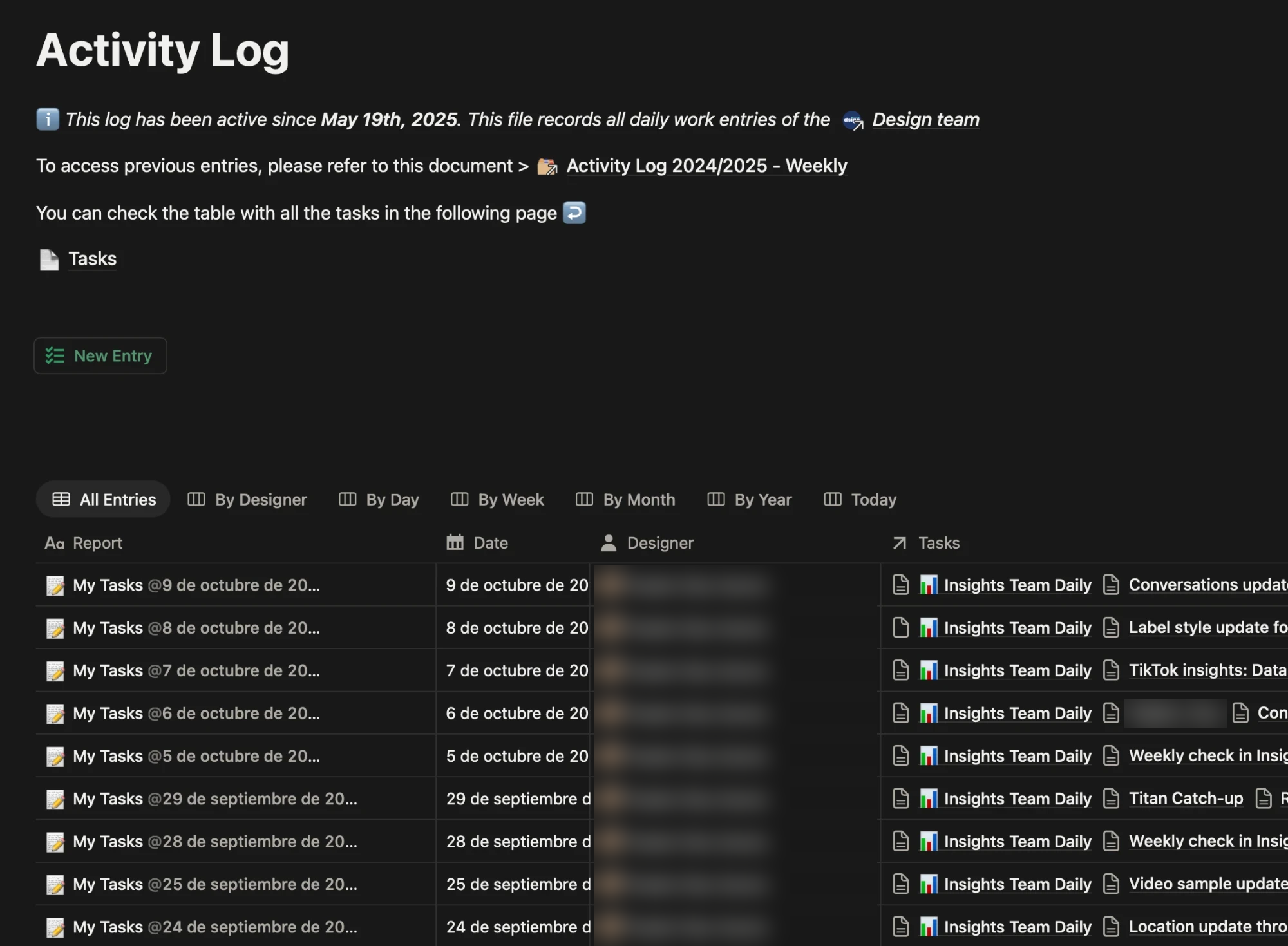
Activity log
Everyone logs their time by activity: roadmap work, design system, support and bugs, research, meetings. At the end of each quarter it becomes the report for leadership: where design time went and what it bought. Roadmap work went from 58% to 74% of design time.
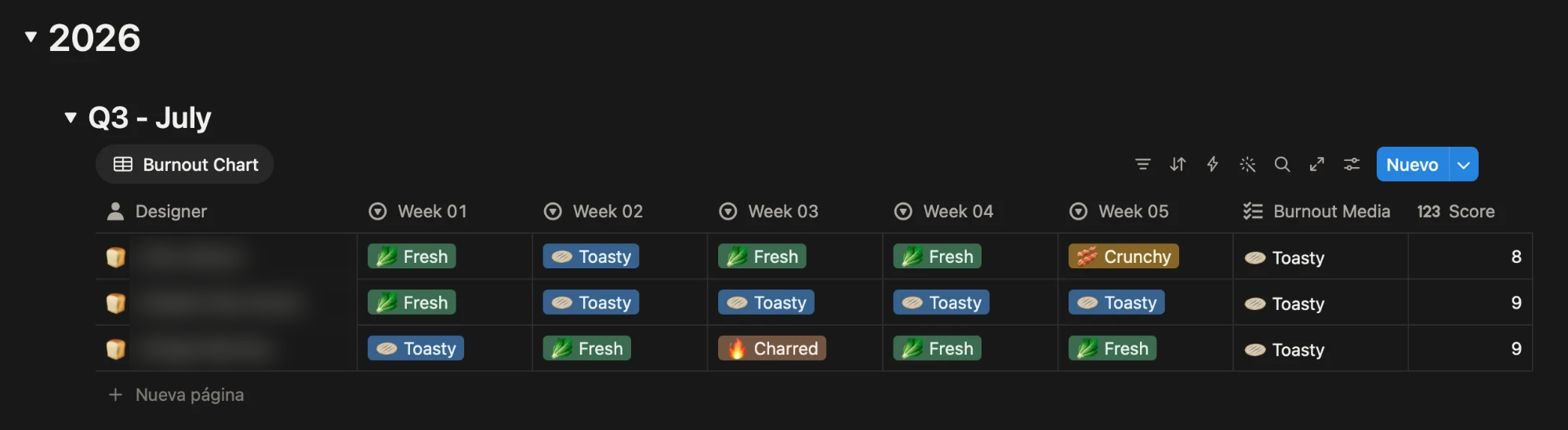
Burnout chart
Every week each designer rates their workload, stress, and pressure, from Fresh (a week we got through without drama) through Toasty and Crunchy to Charred (it needs my attention). Each rating carries points, and the chart shows each person's average and score. Charred means we cut scope, not add hours. During the 2026 reorg it showed overload three weeks before anyone said it out loud.
Decisions written down
Every design decision that affects more than one screen goes into a decision log with the options we rejected. 140+ entries so far. New people read it on their first day, and engineers stop reopening settled questions.
Review the build, not the mockup
With the design system in code, we stopped writing redlines. Designers review the running screen in a preview. Design-related tickets reopened after handoff dropped 45%.
Hard calls
A paid internship, not free labour
Interns are paid, own real tickets, and ship to production, paired with a designer. It costs more than a course and less than a bad hire. Ten interns over five cohorts, and every designer I hired came from it.
Alumni run the next cohort
The first two hires supervised the next two. Mentoring is part of how a designer grows on this team, and it meant I was not the bottleneck for every review.
Letting two designers go to another division
In the 2026 reorg I did not fight to keep headcount. Two designers moved with the products that moved, with a written handover. The three of us kept the design system, the flagship, and the unified app, and leaned harder on the system to make that possible.
Pausing the internship
A program without people to mentor it is unpaid work with extra steps. With three of us, I paused it until 2027 rather than run it badly.
Results
A team that did not exist in 2020 delivered Titan v2, the unified Audience Intelligence App, and a steady flagship roadmap.
92% of sprint tickets now have approved design before the sprint starts, up from 55%. Roadmap work went from 58% to 74% of design time. Nobody has quit the team since 2020, and the score for "I know what matters this quarter" went from 3.1 to 4.4 out of 5.
After the reorg, the same rhythm and the same system let three people cover what five covered before, with the burnout chart as the check that it stays sustainable.
The work on this site is the team's work. My part is the system around it, and the screens I still design myself.